Cyber Essentials First Step Fund: 75% Off for UK SMEs
The government-backed First Step Fund gives eligible UK small businesses 75% off a new Cyber Essentials assessment. Who qualifies, what it costs, the 31 March 2027 deadline and how to apply.
Standfirst
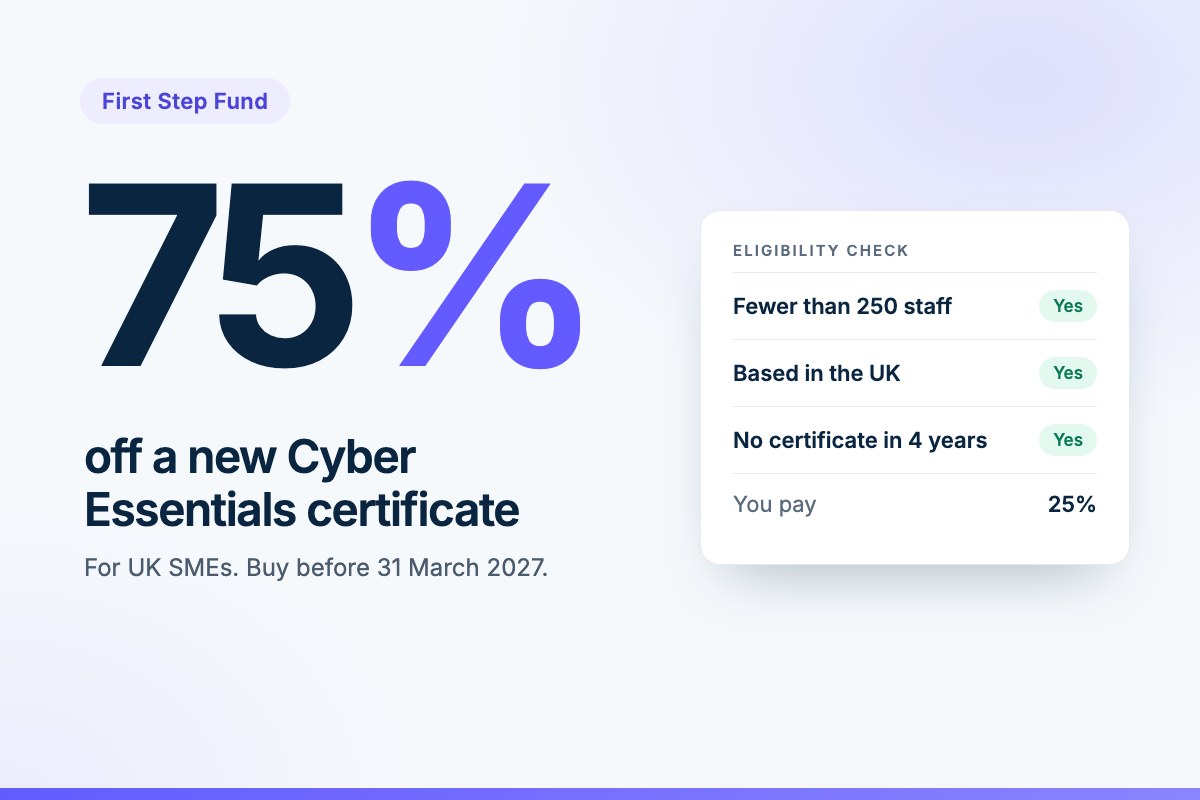
Quick answer. The Cyber Essentials First Step Fund gives eligible UK small and medium-sized organisations 75% off a new Cyber Essentials assessment. You qualify if you have fewer than 250 employees, are based in the UK, and have never certified or have not held a Cyber Essentials certificate in the last four years. Buy your assessment before 31 March 2027 (or until the funding runs out) and finish it within six months.
75%
off a new Cyber Essentials assessment
Under 250
employees to be eligible
31 March 2027
last day to buy, or until funding runs out
Section 01
What is the Cyber Essentials First Step Fund?
The First Step Fund is a government-backed discount on Cyber Essentials, the UK's baseline cyber security certification. It was announced on 3 November 2026 as part of a Cyber Essentials funding package, and it is delivered through IASME, the organisation that runs Cyber Essentials for the National Cyber Security Centre (NCSC).
Many people search for it as "Cyber Essentials First Steps". The official name is the First Step Fund. It is aimed at small businesses that have not certified before, and it cuts the cost of the assessment by 75%. You pay the remaining 25%.
Cyber Essentials checks five technical controls: firewalls, secure configuration, user access control, malware protection and security update management. A pass gives you a certificate that customers, tender portals and insurers recognise. If you want the full picture first, read our guide to whether Cyber Essentials is worth it.
Section 02
Am I eligible for the First Step Fund?
IASME sets three conditions. Your organisation must:
- be a micro, small or medium-sized organisation with fewer than 250 employees;
- be based in the UK; and
- be applying for the first time, or not have held a Cyber Essentials certificate within the last four years.
The funding is for a new Cyber Essentials certificate. It is not a renewal discount, and an organisation that certified within the last four years will not qualify. Organisations that do not meet the criteria can still buy Cyber Essentials at the standard price.
If you are unsure whether your set-up counts, see can small businesses get Cyber Essentials.
Section 03
How much does Cyber Essentials cost with the 75% discount?
Neither GOV.UK nor IASME publishes a single discounted price. IASME says eligible organisations pay "the remaining 25%", and that the cost depends on organisation size. As a guide, here is that 25% applied to IASME's standard Cyber Essentials prices, which we last checked on 7 September 2026. Micro means up to 9 people, small means 10 to 49 and medium means 50 to 249.
Swipe across the table to view all columns.
| Size | IASME standard price (ex VAT) | Indicative price after 75% off (ex VAT) |
|---|---|---|
| Micro | £320 | £80 |
| Small | £440 | £110 |
| Medium | £500 | £125 |
These figures are our own arithmetic, not a quoted price. Your exact cost is confirmed when you apply, and VAT is added on top. If you do not qualify, or the funding runs out, you pay the standard price. Fig Group's standard prices are on our pricing page, and our full UK cost guide explains what drives the difference between providers.
The discount covers the assessment fee. It does not cover your own time, or any changes you need to make to your devices, accounts and settings before you can pass.
Section 04
How do I apply for the First Step Fund?
There are two routes, and the discount is the same on both. You can apply directly on IASME's First Step site, or you can speak to a Cyber Essentials Certification Body or Assured Service Provider, who can access the funding for you. GOV.UK confirms that the discount still applies if you certify through a Certification Body.
Step 1: Check you are eligible
Confirm you have fewer than 250 employees, are UK-based and have not held a certificate in the last four years. IASME's First Step site will tell you if you qualify.
Step 2: Choose your route
Enquire now to get your discount. You can also apply directly through IASME, and the discount applies either way.
Step 3: Buy before 31 March 2027
The assessment must be purchased before 31 March 2027. Funding is limited, so earlier is safer.
Step 4: Complete it within six months
After purchase you have six months to complete and submit the assessment. Fix any gaps in your devices, accounts and settings first.
Step 5: Pass and certify
If you pass, you receive a Cyber Essentials certificate. It is valid for 12 months, so diarise your renewal date.
Section 05
What does the First Step Fund not cover?
Read the small print before you rely on the discount. Based on the GOV.UK and IASME pages as published in early November 2026:
- It does not guarantee certification. Funding covers the cost of the assessment and, if you pass, the certification. You still have to meet the requirements.
- It is for new certificates. Renewals within four years of a previous certificate are not eligible.
- It is time-limited and capped. GOV.UK says the scheme runs until the end of March 2027 "or until funding runs out". IASME says funding is limited and encourages organisations to act early.
- Cyber Essentials Plus is not mentioned. Both pages describe the discount for Cyber Essentials only. Check the current terms with IASME or your Certification Body before assuming it applies to a Plus audit. Our guide to Cyber Essentials Plus explains how Plus differs.
- Your preparation is yours to fund. Time spent fixing settings, replacing unsupported devices or enabling multi-factor authentication is outside the discount.
Section 06
What do I need ready before I start?
Assessors look for evidence that five controls are in place across the devices and cloud services in scope. Have these answers to hand:
- Firewalls: a boundary or software firewall is on for every in-scope device, with no unnecessary open ports.
- Secure configuration: default passwords are changed, unused accounts and software are removed, and device unlock is protected.
- User access control: staff have only the access they need, and admin accounts are separate from daily use accounts.
- Malware protection: anti-malware or an approved application allow-list is running on devices.
- Security update management: supported operating systems and apps, with critical and high-risk fixes installed within 14 days.
Multi-factor authentication must be on wherever it is available, and always for cloud services. Our plain-English guide to the version 3.3 changes shows what has changed.
Section 07
First Step Fund or Cyber Resilience Pledge grant?
The same funding package also includes a second scheme, and the two are easy to confuse. They are different.
First Step Fund
- Support: 75% discount on a new assessment.
- Who can apply: eligible UK organisations with fewer than 250 employees.
- How you get it: apply to IASME or a Certification Body.
- Timing: purchase before 31 March 2027.
Cyber Resilience Pledge grant
- Support: fully funded certification, with Cyber Advisor support.
- Who can apply: selected SME suppliers of organisations that signed the pledge.
- How you get it: your customer nominates you through the pledge process.
- Timing: GOV.UK gives an end date of March 2029. IASME sets a first allocation deadline of 15 March 2027.
You cannot apply for the pledge grant directly. If a customer has asked you to get Cyber Essentials, ask whether they have signed the pledge. Fig Group has signed it too, and we explain what that means in our pledge announcement.
Section 08
Should I apply now or wait?
Apply now if you qualify. The scheme ends on 31 March 2027 at the latest, and it can close earlier if the funding runs out. Because you have six months after purchase to complete the assessment, buying early also gives you time to fix issues without rushing.
Waiting risks paying the full price for the same certificate. A certificate also opens doors sooner: many tenders and supplier questionnaires ask for it, and IASME says eligible UK organisations with turnover under £20 million may receive included cyber insurance when they certify their whole organisation. Check the terms of that insurance before relying on it.
Frequently asked questions
Choose a question to see the practical next step.
01What is the Cyber Essentials First Step Fund?
It is a government-backed scheme giving eligible UK small and medium-sized organisations a 75% discount on a new Cyber Essentials assessment. It is delivered by IASME and runs until the end of March 2027 or until the funding runs out.
02Is Cyber Essentials free under the First Step Fund?
No. The First Step Fund is a 75% discount, so you pay the remaining 25%, plus VAT. A separate Cyber Resilience Pledge grant offers fully funded certification, but only to selected suppliers nominated by organisations that signed the pledge.
03How much does Cyber Essentials cost after the 75% discount?
IASME says you pay the remaining 25% and that the cost depends on your organisation size. Applying 25% to IASME's standard prices gives roughly £80 for a micro business, £110 for a small business and £125 for a medium business, before VAT. Treat these as indicative and confirm your price when you apply.
04Who is eligible for the First Step Fund?
You must be a UK-based organisation with fewer than 250 employees, and either applying for the first time or not have held a Cyber Essentials certificate within the last four years.
05Can I use the discount to renew Cyber Essentials?
Generally no. The fund is for new certificates, and an organisation that held a certificate in the last four years is not eligible. A renewal after 12 months would normally fall outside the scheme.
06Does the 75% discount cover Cyber Essentials Plus?
The GOV.UK and IASME announcements describe the discount for Cyber Essentials and do not mention Cyber Essentials Plus. Confirm the current position with IASME or your Certification Body before assuming Plus is covered.
07What is the deadline for the First Step Fund?
You must buy your assessment before 31 March 2027, and then you have six months to complete and submit it. The scheme can close earlier if the funding runs out, so apply as soon as you are ready.
08Do I have to apply through IASME?
No. You can apply on IASME's First Step site or go through a Cyber Essentials Certification Body such as Fig Group, which can help you claim the discount. GOV.UK confirms the discount still applies if you certify through a Certification Body.
09Does the funding guarantee that I will pass?
No. GOV.UK states that funding covers the cost of the assessment and, where it is passed, certification, but does not guarantee certification. You must still meet the Cyber Essentials requirements.
Section 10
Sources
This guide was reviewed on 16 November 2026. Funding terms can change, so confirm the current position with the official sources.
About the author

Jay Hopkins
Managing Director, Fig Group
Jay Hopkins is the Managing Director of Fig Group and an IASME-licensed Cyber Essentials assessor. He was previously Head of Technology for a global regulated firm. He works with UK organisations across regulated sectors on baseline compliance, supply-chain assurance, and AI-augmented security tooling.
Related guides
Continue reading

Compliance
Cyber Essentials Cost 2026: Complete UK Pricing Guide
How much does Cyber Essentials certification cost in 2026? See every organisation-size tier, what Fig Group includes, renewal costs and additional expenses to check before buying.
Read article
Guides
Can small businesses get Cyber Essentials?
Yes - Cyber Essentials is designed for UK small businesses. Fig Group prices the Micro tier for organisations with 1-9 staff at £299.99 + VAT. An eligible scheme-level cyber-liability benefit is arranged separately by IASME and its insurance partner.
Read article
Compliance
How Long Does Cyber Essentials Take? Honest Timelines for 2026
From readiness to certificate, how long does Cyber Essentials really take? This guide walks through every stage with realistic timelines and the factors that speed it up or slow it down.
Read article